
How Long Do Composite Veneers Last?
If you are considering composite veneers, one of the first questions you will ask is: How long will they last? This is a very natural concern. When dental treatment is applied to your natural teeth, you want to know how many years it will look good and function without problems.
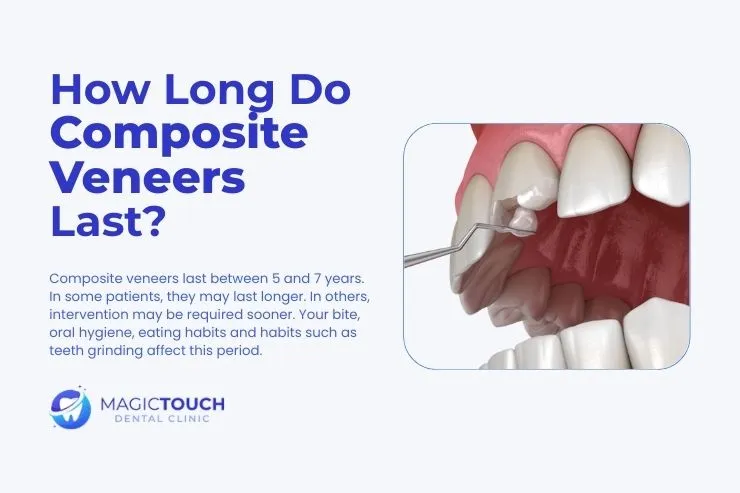
Composite veneers are made from resin material that matches the colour of your teeth. This material is moulded directly onto the tooth, carefully polished and adjusted to fit your bite. Treatment is usually completed in a single session and often requires no grinding of the tooth. This is one of its greatest advantages. However, durability depends on many factors. Generally, composite veneers last between 5 and 7 years. In some patients, they may last longer. In others, intervention may be required sooner.
The usage period is not a fixed number. Your bite, oral hygiene, eating habits and habits such as teeth grinding affect this period. Let's explain realistically what changes over time.
What happens to composite veneers after 5 years?
After 5 years, most composite veneers are still functional. However, routine check-ups often reveal some minor changes. The brightness diminishes slightly. Composite cannot maintain its surface brightness as long as porcelain. Slight discolouration may occur, particularly in areas close to the gum line. If the patient consumes a lot of coffee or smokes, the colour change may be more noticeable.
Small cracks may also form at the biting edges. These are usually seen on the incisal edges of the front teeth. However, there is one advantage: composite is a repairable material. Material can be added and polished in a single session. The gums are also important. If oral hygiene is inadequate, inflammation may develop at the gum line. When the gums recede slightly, bonding border may become visible. This does not mean the veneer has failed.
What happens to composite bonding after 10 years?
After 10 years, renewal or comprehensive repair is generally considered. At this stage, surface wear is common. The incisal edges may appear shorter. The surface may feel less smooth. Discolouration may be deeper, and polishing may not fully restore the original shine.
It is important to note that 10 years is actually a good lifespan for composite bonding. At this point, renewal is not a failure; it is expected maintenance. Another advantage of composite veneers is that renewal is usually straightforward. Since no tooth material is removed initially, aggressive re-preparation is not required.
Factors that affect lifespan composite veneer
- The most important factor is the occlusal force. Patients who grind their teeth at night exert excessive pressure. If a night guard is not used, this significantly shortens their lifespan.
- Dietary habits also play a role. Frequent consumption of acidic beverages gradually softens the composite surface. Hard foods increase the risk of breakage. Smoking and coloured beverages accelerate staining.
- Oral hygiene plays a major role. Plaque build-up in the marginal areas can cause discolouration and gum inflammation. Healthy gums ensure that veneers look good for longer.
- The dentist's application technique is also important. Correct layering, good polishing and correct bite adjustment determine long-term success.
Maintenance tips for long-lasting composite bonding
- Good oral hygiene is essential. Brush twice daily with a non-abrasive toothpaste. Excessively abrasive whitening toothpastes can scratch the surface and reduce shine.
- Use dental floss carefully every day. Healthy gums extend the life of veneers.
- If patients grind your teeth, use a night guard. This single measure can significantly extend the life of composite restorations.
- Avoid biting hard objects: ice, pens or fingernails. Composite is strong but not unbreakable.
- Having a professional polish once or twice a year helps keep the surface smooth and minimises discolouration.
Repair and replacement options
One of the greatest advantages of composite veneers is that they are repairable. Small chips can be easily repaired. Minor discolouration can be polished away. Surface wear can sometimes be corrected by adding new composite material. If veneer has become severely discoloured or structurally compromised, it may be advisable to replace it entirely. This procedure involves removing the old composite and applying a new one. When performed carefully, replacement does not damage the natural tooth. For this reason, composite bonding is considered a protective treatment.
Comparison between composite bonding and porcelain veneers
When comparing solely in terms of lifespan, Antalya porcelain veneers are generally more durable. Porcelain veneers last between 10 and 12 years. They are more resistant to staining and better at maintaining their shine. They are also harder and more resistant to wear and tear.
Composite veneers, on the other hand, last an average of 5 to 7 years. They are more economical and less invasive, but require more maintenance over time.
The decision is not solely dependent on the duration of use. The budget, amount of tooth structure to be removed, bite and aesthetic expectations are also important. Composite may be a good choice for younger patients or those who want a reversible option. Porcelain may be more suitable for patients who want maximum durability and colour stability.