
Dental implants
in Antalya, Turkey:
Procedure and prices
Tooth loss is an important problem that significantly affects the quality of life in terms of functional and aesthetic aspects. In modern dentistry, dental implants that provide biomechanical compatibility with bone tissue provide an effective solution in the treatment of tooth deficiencies.
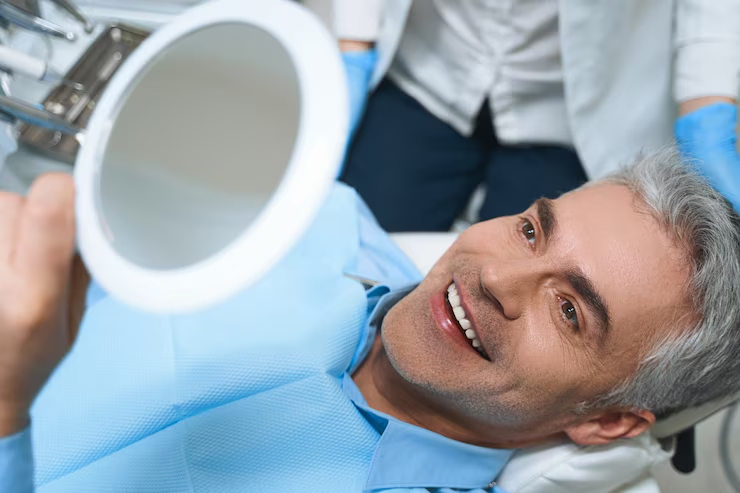
Titanium implants gradually fuse with the jawbone and provide strong support for replacement teeth.
This treatment method makes it possible for those with tooth loss to regain their chewing functions and achieve an aesthetic appearance close to natural.
What is a dental implant?
A dental implant is a titanium-based artificial tooth root that is surgically implanted into the jawbone to restore the function and aesthetics of missing teeth. Dental implants are designed to function like natural tooth roots. The implant surface, produced from biocompatible titanium alloy, completes the biomechanical bonding process called ‘osseointegration’ by direct contact with bone tissue. This creates a strong and stable foundation for the artificial tooth.
Who can benefit from dental implants?
Dental implants are typically required in cases of tooth loss where aesthetic concerns and functional impairments exist, and when alternative prosthetic treatments – which involve replacing missing teeth with aesthetically pleasing prostheses while maintaining oral integrity – prove unsuitable or inadequate.
Single tooth loss
Dental implants can effectively replace a single missing tooth while preserving adjacent healthy teeth. Unlike traditional bridges that require grinding down neighboring teeth for support, an implant-supported crown provides a conservative treatment alternative. This solution most closely replicates both the function and appearance of a natural tooth.
Multiple missing teeth
When replacing multiple missing teeth, dental implants can serve as anchors for either fixed bridges or removable dentures. This approach is particularly advantageous in posterior regions where traditional tooth-supported restorations may be impractical. Compared to conventional partial dentures, implant-supported prostheses offer superior stability while being more conservative with remaining tooth structure.
Complete edentulism
For completely edentulous patients, implants provide a secure foundation for full-arch restorations.
Fixed prosthesis options
- Full arch fixed bridges are ideal for complete edentulism
- Provide natural chewing function and completely eliminate denture movement
Prevention of bone resorption
Following tooth extraction, progressive jawbone deterioration (resorption) occurs due to lack of mechanical stimulation. Dental implants mimic natural tooth roots by stimulating the jawbone during chewing, thereby
- Preserving bone volume and density
- Maintaining facial structural support
- Helping maintain natural facial structure associated with long-term edentulism
Replacing missing back teeth
In cases of posterior tooth loss, implants allow for fixed prosthetic solutions where conventional methods face limitations. Compared to removable partial dentures (with inherent stability issues) and traditional bridges (requiring extreme cantilever designs), implant-supported restorations are a more stable and comfortable solution.
Natural-looking results
To provide a natural appearance
Implants provide an aesthetic appearance with crowns placed on them. Especially for missing teeth in the anterior region, aesthetic results are of great importance, and implants can fulfil this expectation.
Improving smile aesthetics
Many patients feel more confident smiling and speaking after treatment.
What materials are dental implants made of?
Dental implants are typically made of titanium, a material that the body readily accepts. Titanium is biocompatible. The most commonly used materials for implants include:
Ceramic materials
Ceramic materials like zirconia are often used as alternatives in cases where:
- Patients have metal allergies.
Additionally, various coatings and surface treatments are applied to enhance implant performance and integration with the jawbone.
Parts of the dental implant system
Dental implant systems consist of three basic components.
Implant body
It is a screw-shaped artificial tooth root made of titanium or zirconium, surgically placed in the jawbone and fuses naturally with the jawbone.
Abutment
After the implant body is placed in the jawbone, there is a need for a support, i.e. an intermediate connection, where the artificial tooth will be placed. The abutment that provides this need is the connection piece that connects the artificial tooth to the implant body.
Replacement teeth
- Single crowns (ceramic or zirconium)
- Implant-supported bridges
- Overdentures (overdentures)
Dental implant procedure in Antalya
Pre-surgical evaluation and treatment planning
First, when you visit MagicTouch Dental Clinic, our expert dentist will evaluate whether you are a suitable candidate for implant treatment. This assessment may include a dental examination, review of your medical and dental history, radiographs (dental X-rays, panoramic X-rays, CT scans), and taking impressions of your mouth.
It is important to check the quality and quantity of your jawbone. If you don't have sufficient healthy bone or gum tissue, a bone graft may be required before implant placement.
Treatment options will be discussed with you, and the most suitable alternatives for your needs will be evaluated. A treatment plan will be created for your implant procedure, and factors such as cost and duration will be reviewed.
Implant placement
- Dental implant placement phase is usually performed under local anesthesia.
- Incisions are made in the gum, and the jawbone is exposed. A hole is carefully drilled in the jawbone in the size where the implant will be placed.
- The implant (a piece of titanium in the form of a screw or cylinder) is gently screwed into the bone and placed in place. The implant is intended to be in close contact with the surrounding bone, which ensures that the implant is initially stable.
- If necessary, the gum is sutured back into place. A cover screw can be placed on top of the implant to prevent bone, soft tissue, or debris from entering the abutment connection area during the healing process.
Healing process
A healing period of 3-6 months is typically required for the implant to integrate with the bone (osseointegration). During this time, the implant becomes immobile and forms a solid foundation for the placement of the prosthesis.
In some cases, the implant may be submerged under the gum tissue and require a minor secondary surgical procedure (stage-two surgery) to expose it before use. During this stage, the cover screw is removed and replaced with a healing abutment (or healing cap). The healing abutment helps the gum tissue heal properly around the implant and creates an ideal transition profile for the prosthesis
Denture placement
- Once the healing is complete, your dentist will arrange several appointments for a permanent crown, bridge, or denture.
- The healing cap is removed and replaced with a piece called an abutment, which connects the implant to the crown or denture. Abutments come in different shapes and sizes depending on the type and location of the denture. Custom-made abutments can help to mold the soft tissue for better aesthetic results.
- An impression is taken to transfer the position of the implant or abutment in the mouth to the laboratory. Impression posts (impression coping) are used for this process.
- In the laboratory, a model is prepared using a copy (analogue) of the implant according to the impression taken. Your permanent crown or denture is designed and manufactured on this model.
- Finally, the prepared crown, bridge, or prosthesis is fixed to the implant by screwing or gluing it to the abutment.
Advantages of dental implants
Dental implants are considered the gold standard for tooth replacement due to their numerous benefits over traditional options like bridges or dentures. Here are the key advantages:
Natural look and feel
- Aesthetic appeal: Implant crowns mimic natural teeth in color, shape, and translucency.
- Comfort: No slipping or irritation, unlike removable dentures.
- Speech improvement: Prevents the "mumbling" or clicking sounds caused by loose dentures.
Superior functionality
- Restored chewing efficiency: Near-normal bite force (up to 90% of natural teeth).
- Stability: Fixed in place, unlike removable dentures that shift while eating or speaking.
Long-term oral health benefits
- Prevents bone loss: Stimulates the jawbone like natural roots, stopping resorption.
- No tooth damage: Unlike bridges, adjacent teeth don’t need to be filed down.
- Reduces gum and jaw problems: Maintains facial structure, preventing "sunken" appearance.
Durability
- Long lifespan: Can last 20+ years, often a lifetime.
- Low maintenance: Brush and floss like natural teeth—no special adhesives or soaking.
Psychological and social benefits
- Boosts confidence: No fear of dentures falling out in public.
- Improves quality of Life: Restores natural smile and speaking ability.
Versatility in treatment options
- Single tooth Replacement: No need to alter neighboring teeth.
- Multiple teeth: Can support bridges without clasps.
- Full-arch restoration: Options like All-on-4® or implant-supported dentures.
What are the disadvantages of dental implants?
Dental implants have some disadvantages and potential complications.
High initial cost
- More expensive than bridges/dentures
- Insurance coverage may be limited (often considered "cosmetic").
Lengthy treatment process
- Bone grafting needed if jawbone is too thin (adds 3–6 months to healing).
- Healing time: 3–6 months for osseointegration before crown placement.
Not suitable for everyone
- Bone density issues: Severe bone loss may require grafts or disqualify a patient.
- Medical conditions: Uncontrolled diabetes, autoimmune diseases, or smoking can lower success rates.
Dental implant aftercare in Antalya
Dental implant treatment is one of the most effective methods of replacing your missing teeth in the most natural way. However, postoperative care is of great importance for the longevity of the implants.
First 48 hours after surgery
- Bleeding:Light bleeding is normal. Apply pressure by biting a clean gauze for 30-60 minutes.
- Swelling:Apply an ice compress for the first 24 hours (10 minutes of ice, 10 minutes of break).
- Do not brush your teeth for the first 24 hours; only use a salt water mouthwash (1 teaspoon of salt + 1 glass of warm water).
- From the 2nd day onwards, you can gently clean with a soft toothbrush.
- Eat soft and cold/warm foods (yogurt, mash, bananas, eggs).
- Avoid hot, spicy, hard and acidic foods.
First 2 weeks
- Smoking slows healing and increases the risk of infection. Do not smoke for at least 2 weeks.
- Alcohol is not recommended for the first 72 hours due to its blood-thinning effect.
- Do not exercise heavily for the first 3 days. High blood pressure can cause bleeding.
- If you have facial swelling, sleep with your head elevated.
- Do not use removable prostheses for the first week unless your doctor recommends it.
Long-term care
- Clean 2 times a day with a soft-tipped toothbrush.
- Use implant floss (superfloss) and interface brush.
- Have a professional cleaning every 6 months.
Dental implants in Turkey
Cost
Turkey has become one of the most preferred destinations for dental implant treatment in recent years. Here are the key factors making Turkey attractive for implants:
Dental implant treatment in Turkey is significantly more economical compared to the US, UK, or other European countries. The primary reason is favorable exchange rates. Despite using high-quality materials and working with expert dentists, the lower costs provide substantial savings for patients.
Combining tourism with treatment (Health tourism)
If you wish to enjoy a holiday in Turkey during your dental implant treatment, you can contact MagicTouch Dental Clinic to learn about the services we offer.
Fast and effective treatment process
- In some clinics, such as our clinic, fixed teeth can be made in a few days with All-on-4 or All-on-6 techniques.
- Appointment waiting times are shorter than in many countries.
Patient satisfaction and reliability
Dental clinics in Turkey have international accreditations (JCI, ISO), and thousands of foreign patients are treated with high satisfaction rates.
F.A.Q
Will I feel pain during dental implant treatment?
The dental implant treatment process is usually painless or slightly uncomfortable. Here is detailed information:
- Since the procedure is performed under local anesthesia, you will not feel pain during the procedure.
- For sensitive patients, sedation (light drowsiness) or general anesthesia can also be offered.
- Mild pain, swelling, or bleeding is normal for the first 24-48 hours.
- The pain level is usually no different from a simple tooth extraction.
- Painkillers (paracetamol or ibuprofen) prescribed by your doctor will provide relief.
- Within 3-7 days, swelling and pain are largely gone.
- Wait 2-6 months for the implant to fuse with the bone (osseointegration); this process is painless.
Once dental implant procedure is started, how long does it take to become fully functional?
The time from the start of the dental implant application to the completion of the rehearsals depends on the patient's condition.
Are there alternatives to dental implants?
Dental bridges and partial or complete dentures can be preferred.
What are All-on-4 and All-on-6?
All-on-4 and Antalya All-on-6 are innovative implant treatments developed for patients experiencing toothlessness or significant tooth loss.
- In All-on-4 dental implants,a fixed prosthesis is created with four implants, and thanks to the implants placed at special angles, bone grafting may not be necessary. This method provides a rapid solution by allowing patients to receive temporary teeth on the same day.
- All-on-6 uses six implants to provide greater support, making it an ideal option particularly for patients with high chewing forces or borderline bone density. Both techniques offer more stable, comfortable, and natural-looking results compared to conventional dentures.
- Turkey has become an attractive center for All-on-4 and All-on-6 treatments for international patients.
How long does the implant process take for someone who has lost all their teeth?
The general timeline for implant treatment for someone who has lost all their teeth varies depending on each individual's condition and the procedures to be performed. However, considering the traditional delayed loading protocol, the period from implant placement to the attachment of permanent prostheses can typically take longer than 6 months, and may extend up to a year if additional procedures like bone grafting are required. This duration can be shortened with immediate or early loading protocols, but the suitability of these options is evaluated by the dentist. You can obtain the most accurate information about treatment duration from your dentist after a detailed examination and treatment planning.
What is the minimum number of implants required for dentures?
The minimum number of implants required for dentures depends on the type of denture and your jaw structure. Here are the details:
For Lower jaw (Mandible)
A minimum of 2 implants is sufficient for an ‘overdenture’ (removable prosthesis). The retention of the removable prosthesis increases, and bone resorption slows down. With 4 implants, it becomes more stable.
A fixed denture (All-on-4) requires at least 4 implants.
For upper jaw (Maxilla)
- Minimum 4 implants: The upper jaw has a softer bone structure, so it needs more support.
- For overdenture: 4 implants recommended.
- For fixed prosthesis (All-on-4/6): 4-6 implants are ideal.
Popular Treatments