Is B1 tooth shade too white?
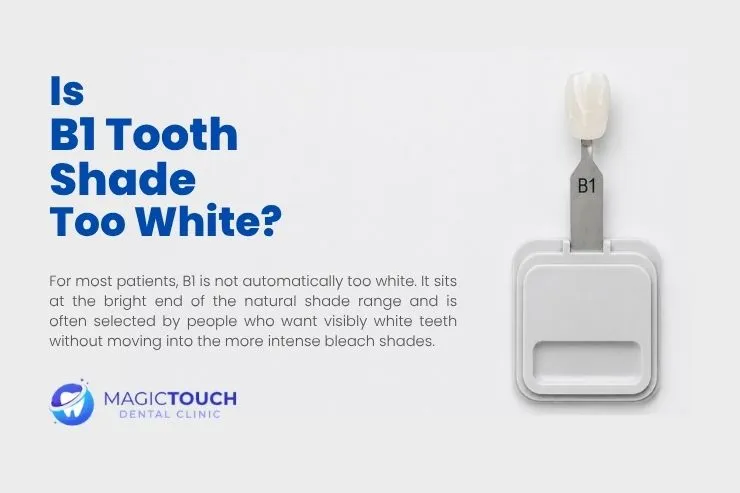
For most patients, B1 is not automatically too white. It sits at the bright end of the natural shade range and is often selected by people who want visibly white teeth without moving into the more intense bleach shades.
However, B1 will not look the same in every smile. It can appear quite subtle when it is matched with the right tooth shape and natural translucency. The more useful question is not simply whether B1 is white. It is whether B1 will work with the rest of your smile.
B1 tooth shade
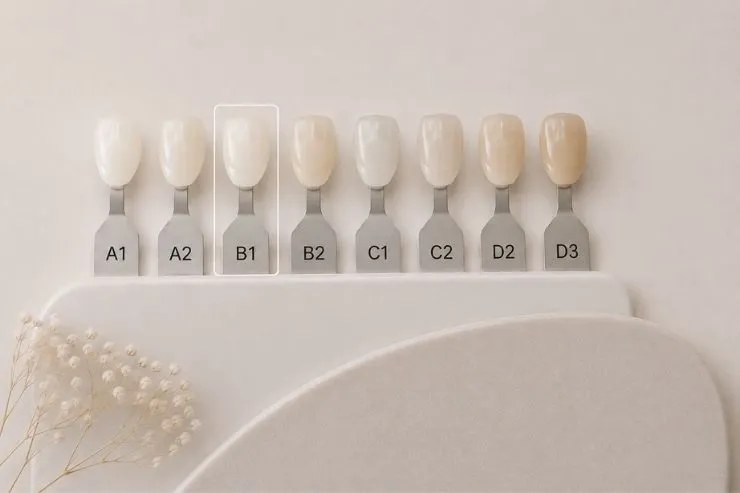
Dentists use shade guides to describe and compare tooth colours. One of the best-known systems is the VITA Classical A1–D4 shade guide. It contains 16 natural shades divided into four groups.
The letter describes the general colour family:
- A shades have reddish-brown characteristics.
- B shades have reddish-yellow characteristics.
- C shades are more greyish.
- D shades have reddish-grey characteristics.
The number distinguishes shades within each family. It should not be read as a simple universal brightness scale across every group.
When patients refer to B1 teeth colour, they are usually describing a clean and luminous white with enough underlying warmth to remain within the natural shade range. It is noticeably brighter than the colour of many untreated adult teeth.
Is B1 a natural tooth colour?
Yes. B1 belongs to a recognised natural tooth shade range. Some people have naturally light enamel that falls close to B1, particularly when they are younger. Other patients may reach a similar shade through professional whitening.
Calling B1 a natural colour does not mean it will blend naturally into every mouth. Untreated teeth often contain small variations in colour. The area near the gum may be slightly warmer, while the biting edge can appear more translucent. A restoration made as one solid block of B1 may therefore look less convincing than one with carefully planned layers and subtle colour variation.
How does B1 compare with other white shades?
B1 is often considered alongside A1 and the brighter bleach shades. They can all produce white teeth, but they do not create precisely the same effect.
The right comparison needs to be made using actual shade samples. Names and online photographs provide a general idea, but they cannot reproduce the exact appearance of dental ceramic or natural enamel.
A1 vs B1 tooth shade
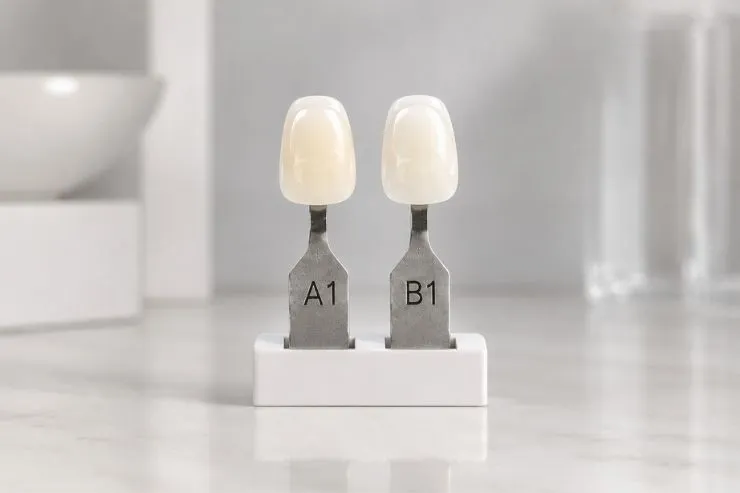
B1 vs A1 tooth shade comparison is popular because both colours sit at the lighter end of the natural range.
B1 belongs to the reddish-yellow B family, while A1 belongs to the reddish-brown A family. In practical terms, A1 can appear slightly warmer or softer. B1 generally presents as brighter when the samples are compared directly.
Neither is inherently better. A1 may suit someone who wants a gentle change or needs a restoration to blend with naturally warm teeth. B1 may be preferred when the aim is a cleaner and more noticeable white.
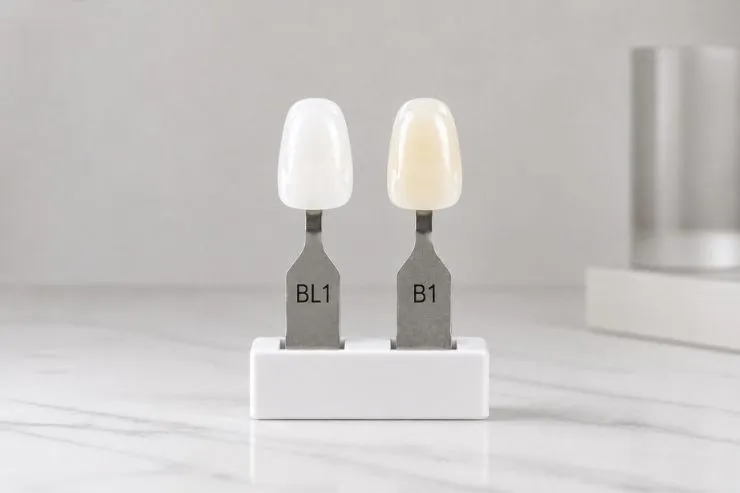
B1 vs BL1 tooth shade
The difference between B1 vs BL1 tooth shade is usually more obvious. B1 belongs to the VITA Classical natural range. BL1 is a bleach shade used in separate shade systems to represent a much brighter white.
BL1 may appeal to patients who want their dental work to look deliberately brilliant. It is commonly associated with a bold cosmetic result.
Patients sometimes describe both colours as “Hollywood white”, but that description is imprecise. One person may use it for any clean, bright smile. Another may mean an exceptionally white set of veneers Antalya. Looking at physical samples is far more useful than relying on the phrase.
Can teeth whitening achieve a B1 shade?
Professional teeth whitening can bring some natural teeth to B1, but the outcome is not identical for every patient. Starting colour, enamel characteristics and the type of staining can affect how the teeth respond.
Yellow-toned staining may respond differently from deeper grey or brown discolouration. Some teeth become substantially lighter without reaching B1. Others may finish at B1 or move into a bleach shade range. A dentist must examine the teeth and gums before deciding whether whitening is appropriate.
Teeth whitening changes the colour of natural teeth, but it does not whiten existing crowns, veneers or tooth-coloured fillings.
If the surrounding teeth are whitened after a crown has been fitted, the crown may no longer match. For that reason, whitening is often completed before the final shade of new restorations is selected. The colour can then be reviewed once it has settled.
Which tooth shade will look most natural on you?
There is no single answer to which tooth shade looks most natural. B1 may be ideal for one patient and unnecessarily bright for another. A1, A2 or a carefully selected bleach shade might work better in a different smile.
Your dentist should consider:
- The colour of any teeth that will remain untreated
- The number and position of the planned restorations
- The underlying colour of the prepared teeth
- The ceramic or restorative material being used
- Tooth shape, size and translucency
- Your preference for a subtle or visibly bright result
- How the chosen colour appears under different lighting
Skin tone may influence how bright teeth appear, but it should not be used as a rigid rule. Two people with similar complexions may prefer completely different results. The better choice is the one that works with your full smile and reflects what you consider natural.
At MagicTouch Dental Clinic in Antalya, tooth shade is assessed during smile planning for veneers, crowns or a Hollywood smile. A clinical examination is necessary before the dentist can recommend a material, shade or treatment plan.
Frequently asked questions
B1 can look natural in real life, especially when the colour is considered as part of the complete smile rather than chosen on its own.
Natural-looking teeth are not defined by shade alone. Light passes through enamel and reflects from the layers beneath it. This produces depth that cannot be recreated by simply choosing a white ceramic. A dental technician must also consider opacity, translucency, surface texture and the way light moves across each tooth.
The surrounding features change how the shade is perceived. Lip colour, gum tone and nearby natural teeth can make B1 appear softer or brighter. Even the amount of tooth visible when you smile can affect the overall impression.
B1 is sometimes called Hollywood white because it creates a noticeably bright smile. Technically, it remains within the natural VITA Classical shade range. Bleach shades such as BL1 produce a more intense white and are more closely associated with the brightest cosmetic results.
B1 can work with many complexions, but skin tone should not determine the choice by itself. Lip colour, gum tone, neighbouring teeth and the design of the restorations all affect how it appears. Personal preference is also important. The shade should be assessed beside your face rather than selected from a chart alone.
The colour of veneers can be reviewed during the planning and try-in stages, and limited adjustments may be possible before they are permanently bonded. Teeth whitening does not lighten the colour of veneers or crowns. If a significant colour change is required, the restorations may need to be remade. It is therefore important to check the colour carefully under different lighting conditions before permanent bonding takes place.
Popular Treatments