
What are the types of dental implants?
Dental implants are a treatment used to restore the function of missing teeth. They are artificial tooth roots placed into the jawbone to support crowns, bridges or dentures. Dental implants are generally classified into three types: endosteal, subperiosteal and zygomatic implants. In addition, depending on the treatment requirements, they can be categorised as single-tooth implants, All-on-4 / All-on-6, same-day implants and mini implants; and depending on the material, as titanium and zirconia implants.
1. Types of dental implants by treatment needs & technique
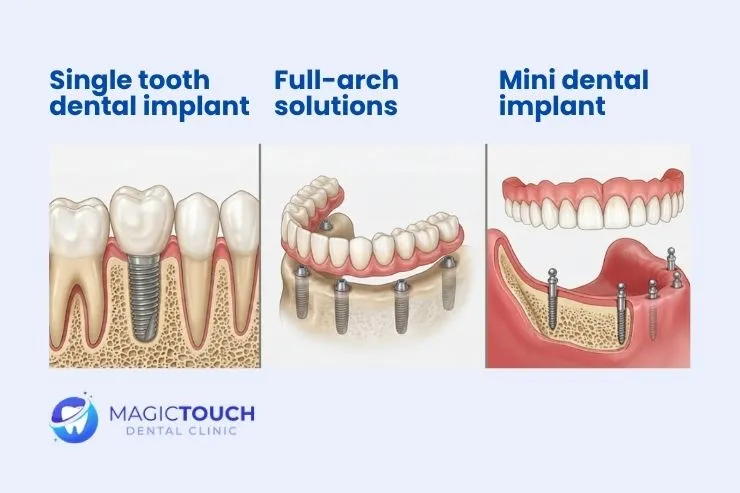
Single-tooth implants
A single missing tooth in the jaw was usually treated with a dental bridge. The disadvantage of this treatment, however, was that it required work to be carried out on the adjacent teeth.
With a single-tooth implant, we can treat the tooth without damaging the neighbouring teeth. Once an implant has been placed in the tooth gap, a custom dental crown can be fitted onto it. This treatment also helps to preserve bone volume.
All-on-4 / All-on-6 implants (Full-arch solutions)
Full-arch implants are used when there are no teeth remaining in a jaw. Following the dentist’s assessment, 4, 5, 6, 8 … implants are placed in the jaw, after which a set of teeth is fixed in place. This is known as the ‘All-on-X’ system. All-on-X implants are designed to support a prosthesis using a small number of implants.
All-on-4 method uses four implants to support a dental prosthesis, whilst All-on-6 method uses six implants. These methods are particularly favoured in cases of multiple tooth loss or complete edentulism.
Same-day dental implants
Same-day dental implants are a treatment approach whereby temporary teeth can be fitted on the same day the implants are surgically placed. This offers advantages for patients who wish to maintain their appearance and do not want to be without teeth for social reasons. This approach is not suitable for everyone, and your dentist will make the final decision. Bone quality and bite force are important factors in this decision.
Mini dental implants (MDIs)
Mini dental implants are thinner than standard implants. They may not be ideal for areas requiring high chewing forces and are a less invasive option.
2. Types of dental implants by material
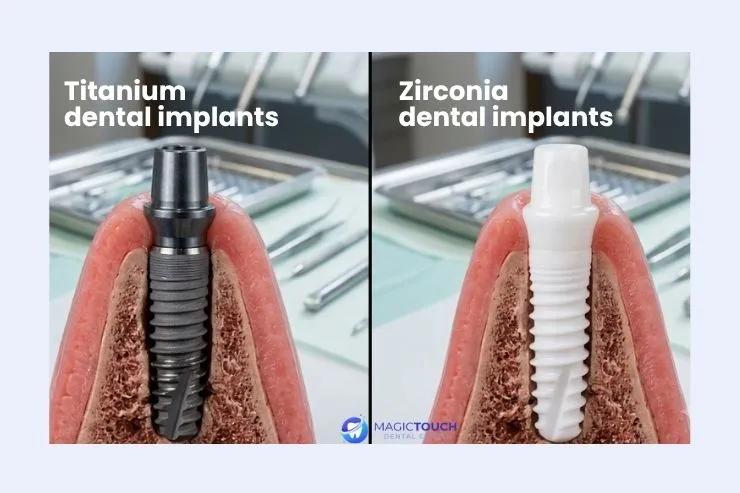
Titanium dental implants
Titanium is the most commonly used implant material. Its durability, biocompatibility and long-term success have contributed to this.
Zirconia (Ceramic) dental implants
Zirconia is a metal-free, ceramic-based material. As zirconia crowns are tooth-coloured, they can offer aesthetic advantages in the anterior region. They may be a suitable option for patients with metal sensitivity.
| Feature | Titanium Dental Implants | Zirconia (Ceramic) Dental Implants |
|---|---|---|
| Material Base | High-grade titanium alloy | Metal-free ceramic (zirconium oxide) |
| Esthetic Profile | Metallic tone (rarely visible unless gums thin) | Tooth-coloured white material; no metal show-through risk |
| Allergy Profile | Extremely low risk; rare metal sensitivities | 100% metal-free; hypoallergenic properties |
3. Types of dental implants by placement location
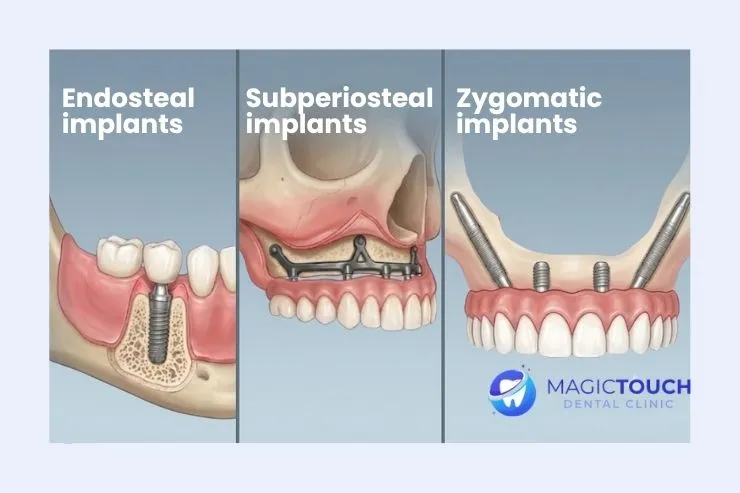
Endosteal implants
Endosteal implants involve the direct placement of a screw-shaped implant into the jawbone. They are the most commonly used type of implant. They provide a solid foundation for dental prostheses in patients with sufficient bone support.
Subperiosteal implants
Subperiosteal implants are placed on top of the jawbone and beneath the gums. They may be preferred for the treatment of patients with insufficient bone volume. Endosteal implants provide a suitable solution in most cases thanks to modern implant techniques. For this reason, they are not frequently chosen. The dentist will decide on this during the consultation.
Zygomatic implants
Zygomatic implants are placed in the cheekbone of patients with severe bone loss in the upper jaw. A fixed full-arch prosthesis is secured onto these implants.
F.A.Q.s
There are essentially three main types of implant: endosteal implants, which are placed directly into the jawbone; subperiosteal implants, which are positioned on top of the bone beneath the gum tissue; and zygomatic implants, which are anchored to the upper cheekbone.
Neither material is inherently superior to the other. While zirconia offers a metal-free, highly aesthetic alternative, titanium has a longer clinical track record and high mechanical durability. The choice of material is made according to the patient’s individual health needs.
The choice of the right implant is determined by bone density, the number and position of missing teeth, and the patient’s general state of health. The most appropriate choice is determined following a consultation with a dentist.
At MagicTouch Dental Clinic Turkey, you can receive dental implant treatment from our experienced dentists. By assessing our patients’ expectations and needs, we help them achieve a natural-looking smile. If you are planning to undergo dental implant treatment in Antalya, please contact us.
Popular Treatments