
How long do dental implants last?
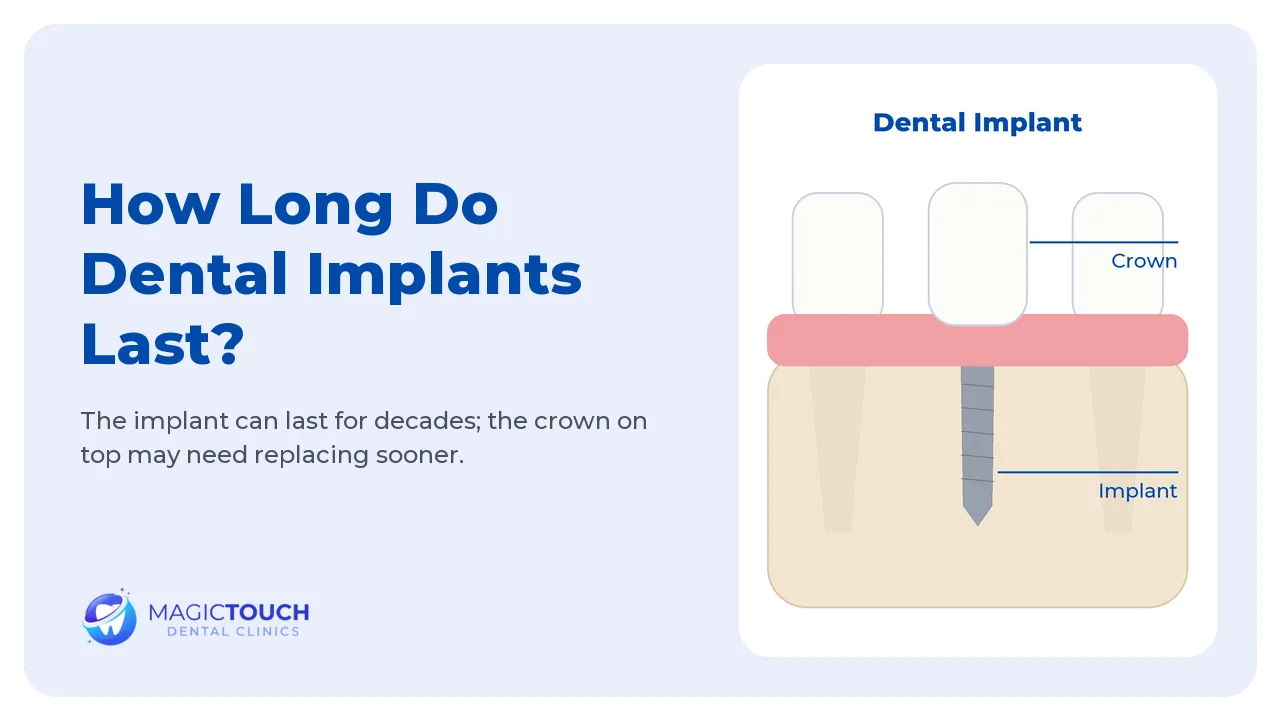
A well-placed dental implant can last for decades, and for many people a lifetime. The crown on top usually has a shorter life, because it is the part that does the chewing. If you are planning treatment in Antalya, Turkey, it helps more to ask what keeps an implant healthy year after year — and much of the answer depends on you.
What does the research say about implant lifespan?
Long-term studies are reassuring.
A systematic review of 18 studies found that 96.4% of implants were still in place after 10 years.1 Another review, covering more than 7,700 implants followed for an average of 13 years, reported a survival rate of 94.6%.2 And a 2024 analysis of studies lasting 20 years concluded that around four out of five implants, or more, were still functioning two decades after placement.3
These are averages from many patients and clinics. Your own result depends on the factors below.
Planning dental implants in Antalya?
Contact MagicTouch Dental Clinic in Antalya, Turkey for a 3D scan assessment and a treatment plan built around your bone and health.
Free ConsultationWhy the implant and the crown last differently
An implant has three parts: the titanium post in the bone, a small connector called an abutment, and the crown you see. The post is protected inside the bone and does not decay. The crown, on the other hand, meets food, pressure and the occasional hard bite every day.
So the crown may chip or wear and need replacing at some point. This is to be expected and is not a sign that the implant has failed. In most cases, a replacement crown is simply made and attached to the existing implant. If a crown comes loose, see a dentist soon; my crown fell out but it does not hurt explains what to do.
What affects how long implants last?
Cleaning and gum health
This is the big one. Plaque around an implant can inflame the gum and, over time, the bone that holds it. Studies show this kind of inflammation is fairly common and becomes more likely the longer implants are in place without good care.4 Daily cleaning and regular professional check-ups keep it under control.
Smoking
A large review of more than 150,000 implants found that implants in smokers were about 2.4 times more likely to fail than those in non-smokers.5 Stopping, or at least cutting down, makes a real difference — especially in the weeks after surgery.
General health
Uncontrolled diabetes and some autoimmune conditions can slow healing and raise the risk of problems. That does not rule implants out. What matters is keeping the condition under control and telling your dentist about your complete medical history.
Grinding and heavy biting
Teeth grinding puts extra force on the crown and the implant. A night guard protects both.
Bone and planning
Implants need enough healthy bone. Before treatment, a 3D scan maps the bone closely, which helps the dentist choose the right position for the implant. Where bone is limited, options such as all on 4 or bone grafting may be considered; the types of dental implants are explained in a separate guide.
Signs an implant needs attention
Implants do not hurt the way a decayed tooth does, so problems can be quiet at first. See a dentist if you notice:
- Bleeding or swelling around the implant
- A bad taste or discharge
- A loose or moving crown
- Discomfort when biting
Most of these problems respond well to treatment when they are spotted early.
Looking after your implants after treatment in Antalya
Implants placed in Antalya can be checked and cleaned by any dentist at home. Day to day, a few habits protect them:
- Brush twice a day and clean between the teeth daily, using interdental brushes or a water flosser around the implant
- Keep up check-ups and professional cleaning, usually every six to twelve months
- Wear a night guard if you grind
- Avoid biting very hard objects such as ice or pen caps
- Avoid smoking, above all during the healing period
The dental implants page covers aftercare for the first days and weeks in more detail.
F.A.Q.
Questions about your implants?
The MagicTouch dental team in Antalya can review your X-rays and explain the right option for your case.
Free ConsultationReferences
- Howe MS, Keys W, Richards D. Long-term (10-year) dental implant survival: a systematic review and sensitivity meta-analysis. J Dent. 2019;84:9–21. doi:10.1016/j.jdent.2019.03.008
- Moraschini V, Poubel LA, Ferreira VF, Barboza ES. Evaluation of survival and success rates of dental implants reported in longitudinal studies with a follow-up period of at least 10 years: a systematic review. Int J Oral Maxillofac Surg. 2015;44(3):377–388. doi:10.1016/j.ijom.2014.10.023
- Kupka JR, König J, Al-Nawas B, Sagheb K, Schiegnitz E. How far can we go? A 20-year meta-analysis of dental implant survival rates. Clin Oral Investig. 2024;28(10):541. doi:10.1007/s00784-024-05929-3
- Derks J, Tomasi C. Peri-implant health and disease. A systematic review of current epidemiology. J Clin Periodontol. 2015;42 Suppl 16:S158–S171. doi:10.1111/jcpe.12334
- Mustapha AD, Salame Z, Chrcanovic BR. Smoking and dental implants: a systematic review and meta-analysis. Medicina (Kaunas). 2021;58(1):39. doi:10.3390/medicina58010039
Popular Treatments